Metering
Spectra
Loudness and analysis metering.
One-time purchase, no subscription. No account, no node-lock, no internet connection. Your license file is emailed the moment payment completes, or try it free for 14 days first.
Covered by Production Expert

Overview
A loudness and audio analysis meter for broadcast, mastering, and recording, built on an ITU-R BS.1770-5 engine with a freely arranged dashboard.
Spectra is a loudness and audio analysis meter for broadcast, mastering, and recording. Drop it on a master bus, or run the standalone against a live feed, and it shows where the program sits against your delivery target: broadcast, streaming or podcast. It does not change the audio.
A second plugin comes with it. With Spectra Send, the standalone reads your DAW or a reference playing on a streaming service, and switches between them by itself.
The loudness engine is ITU-R BS.1770-5, checked against the official EBU Tech 3341/3342 conformance test vectors and cross-checked sample-for-sample against libebur128 (155 comparisons, zero failures). The same code path runs live or offline, so a reading taken while mixing matches the reading taken again on the finished file. The project accuracy bar is ±0.1 LU against the reference vectors, and the test suite enforces it on every build.
Every meter lives on one freely arranged dashboard: numeric loudness tiles, True Peak, VU, spectrum analyzer, scrolling spectrogram, goniometer and compliance panels. Twenty-five panels can be moved, resized, added, or removed, and any arrangement can be saved as a preset.
Mono and stereo through to 5.1, 7.1, 7.1.2, 7.1.4 and 9.1.6 are all measured, with per-channel weighting to ITU-R BS.1770-5 Annex 3 and LFE excluded from every integration. Three of the factory layouts are built for surround, giving the per-channel bars the width they need to be read at twelve or sixteen channels.
Features
ITU-R BS.1770-5 / EBU R128 loudness engine
Momentary, Short-term, Integrated loudness and Loudness Range (LRA), gated per spec.
True Peak (dBTP)
4×/8× oversampling FIR reconstruction rather than linear interpolation, alongside Sample Peak (dBFS) with an Over latch.
PLR / PSR and VU
Crest-factor readouts, plus an analog-style VU meter with IEC 60268-17 ballistics.
Spectrum, spectrogram, goniometer
Real-time spectrum analyzer, scrolling spectrogram, and goniometer for stereo image and frequency content.
Fully freeform dashboard
25 panel types on a 24×16 snap grid; drag, resize, add, or remove any panel. Ships with 11 factory presets, three of them surround, plus user-savable custom presets.
Spectra Send
Sends one track to the standalone, one at a time. VST3, AU, CLAP and AAX on macOS; VST3 and CLAP on Windows.
13 built-in delivery targets
EBU R128, ATSC A/85, ARIB TR-B32, OP-59, Spotify, YouTube, Apple Music, Netflix, Amazon Music, TIDAL, Deezer, Podcast, and Music Reference −14, with live Compliance, a Compliance Matrix (pass/fail and trim-to-hit across every target at once), and Streaming Preview.
Five built-in color skins
Modern, Amber, Aurora, Classic and Tricolore. Each has its own accent color, which you can change.
One-click QC report export
PDF, JSON, and CSV together from one dialog.
Band Loudness
K-weighted level across ten octave bands (31.5 Hz–16 kHz), highlighting whichever band is currently driving the loudness.
14-day full-featured trial
One-time-purchase license, no subscription. Offline .gbc license file: no account, no node-lock, no telemetry.
One dashboard, arranged your way.
25 panel types on a 24×16 snap grid. Eleven factory presets ship with the plugin, and any arrangement you build can be saved as your own.
Spectra Send
Ships with the meter. Insert it on the track you want to measure.
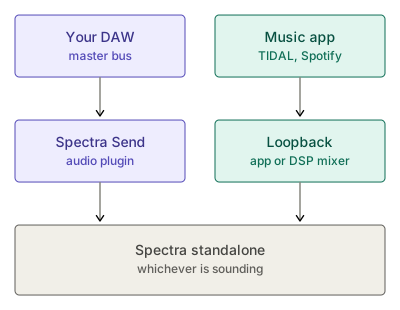
From there the standalone measures whichever source is actually making sound. Play a reference on TIDAL or Apple Music and it reads that. Press play in the DAW and it follows your mix instead. There is no source selector. It switches by itself. Each switch resets Integrated, LRA and True Peak Max, so readings from two sources are never mixed.
That puts a commercial release and your own mix in the same window, against the same target, without importing anything into the session. The targets for Spotify, Apple Music, TIDAL and Amazon Music are already in the list.
It also makes the standalone usable where the DAW holds the audio device, Pro Tools HD/HDX among them. Send reaches it with no audio device in the path at all, at the session's own sample rate.

A streaming service plays to an output, and the standalone listens to an input. To meter one, route it back with a loopback app or the loopback channel in your interface's DSP mixer.
Five skins.
Five color skins. Each has its own accent color, which you can change.

Specifications
| Format | macOS | Windows |
|---|---|---|
| Standalone applicationCore Audio on macOS; ASIO or Windows Audio on Windows | Yes | Yes |
| VST3 | Yes | Yes |
| Audio Unit (AU) | Yes | — |
| CLAP | Yes | Yes |
| AAX Native | Yes | Yes |
The installer ships VST3, CLAP, AAX and the Standalone application on both macOS and Windows. Audio Unit is macOS only. ASIO is a trademark of Steinberg Media Technologies GmbH, registered in Europe and other countries.
| Requirements | macOS | Windows |
|---|---|---|
| OS version | macOS 10.15 Catalina or later (Intel) · macOS 11.0 or later (Apple Silicon) | Windows 10 version 1607 or later, 64-bit |
| CPU | Apple Silicon or Intel (Universal binary) | 64-bit Intel or AMD |


